Skip to content

Blog

Knobless Cylinders Blog
Knobless Cylinders Banner

At Joyous Montessori, learning is always active, hands-on, and thoughtfully connected to the world around us. Each month, our classrooms are filled with curiosity as children explore a wide range of cultural, scientific, and sensorial topics alongside purposeful Montessori materials.

Recently, students have been learning about fascinating subjects such as the planet Mars, President Thomas Jefferson, the continent of North America, and the life cycle of a butterfly. Alongside these studies, children are also deepening their understanding through hands-on work with classic Montessori materials. Two favorites in the classroom right now are the Trinomial Cube and the Knobless Cylinders, both powerful tools for developing concentration, logic, and early mathematical thinking.

The Trinomial Cube

The Trinomial Cube

The Trinomial Cube is often introduced after a child has confidently mastered the Binomial Cube. While it looks like a colorful puzzle at first glance, it offers a much deeper learning experience.

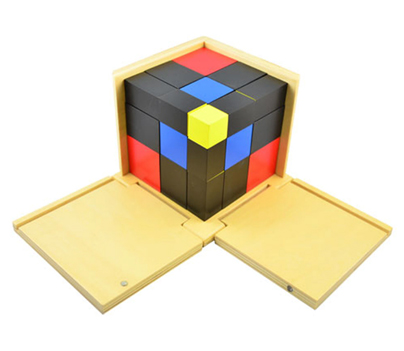
The Trinomial Cube consists of:

  • One yellow cube, one blue cube, and one red cube
  • Eighteen square-based prisms
  • Six black rectangular prisms
  • A wooden box that holds all the pieces together

The child’s goal is to carefully assemble all 28 pieces into a perfect cube, ensuring that each side matches the colors of the adjacent pieces. Initially, children approach the Trinomial Cube as a sensorial challenge, relying on visual discrimination, spatial awareness, and problem-solving skills to complete the cube.

With repeated practice, however, the learning goes far beyond matching colors. Over time, children begin to internalize advanced mathematical concepts related to algebra, specifically the trinomial expression (a + b + c)³. While the child may not yet use algebraic language, the concrete experience lays a strong foundation for abstract thinking later in their academic journey.

Through this work, children strengthen:

  • Logical reasoning
  • Concentration and patience
  • Visual-spatial skills
  • Early algebraic understanding

The Trinomial Cube beautifully demonstrates how Montessori materials move from concrete to abstract learning in a natural, developmentally appropriate way.

The Knobless Cylinders

The Knobless Cylinders

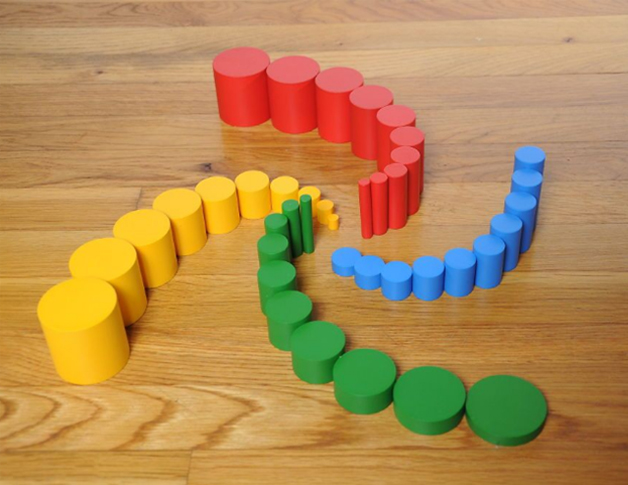
The Knobless Cylinders are another essential Montessori material that helps children refine their understanding of size, dimension, and order. These cylinders come in sets of ten and are grouped into four distinct color-coded sets, each with its own unique pattern of variation.

  • Red Cylinders: All are the same height, but gradually increase in diameter
  • Yellow Cylinders: Increase in both height and diameter
  • Green Cylinders: Also increase in height and diameter, but in a different proportion
  • Blue Cylinders: All share the same diameter but vary in height

Children begin by arranging each set in order, from smallest to largest, carefully observing differences in height and width. They may also stack the cylinders to build towers or experiment with combining cylinders from different sets once they gain confidence and control.

As children become more skilled, they often challenge themselves by matching cylinders of one color with compatible cylinders of another color, discovering relationships between dimensions and proportions. The possibilities are endless, allowing children to explore freely while still working within a structured framework.

Working with Knobless Cylinders helps children develop:

  • Fine motor control and hand-eye coordination
  • Visual discrimination
  • An understanding of dimension and measurement
  • Preparation for geometry and mathematical reasoning

This material is especially valuable because it invites repetition, experimentation, and self-correction, key elements of meaningful Montessori learning.

Why These Materials Matter

Why These Materials Matter

Both the Trinomial Cube and the Knobless Cylinders reflect the heart of Montessori education: hands-on learning that builds deep understanding over time. These materials encourage children to think critically, solve problems independently, and gain confidence in their abilities.

At Joyous Montessori, we intentionally guide children through experiences that support not just academic growth, but also independence, focus, and a genuine love for learning. We invite families to visit our classrooms and see firsthand how these timeless Montessori materials help children grow into capable, confident learners, one thoughtful activity at a time.

Exciting things are happening at Joyous Montessori! This month, we are studying the planet Mars, President Thomas Jefferson, the continent of North America, and the life cycle of a butterfly. We are also working intensely with many Montessori tools, including the two I will describe below.

The Trinomial Cube

Students who have mastered the binomial cube will get an extra challenge when they are given the trinomial cube. The trinomial cube is a puzzle cube with twenty-eight pieces:

  • One yellow, one blue and one redcube.
  • Eighteen square based prisms.
  • Six black rectangular prisms.
  • A box to hold it all in.

As with the binomial cube, the object is to assemble all the parts into a cube in such a way that every piece is placed with all sides matching the color of every adjacent side. At first glance, the child will perceive the trinomial cube as a sensory puzzle – they use their sense of sight to match sides together. However, after working for awhile with the cube, children will begin to grasp algebraic concepts, including (a+b+c)
The Knobless Cylinder

Knobless cylinders come in groups of ten, in four different colors. The red cylinders are all the same height, but each successive cylinder increases incrementally by diameter. A row of yellow cylinders increases in both height and diameter, so that the widest cylinder is also the tallest. A row of green cylinders increases both dimensions in such a way that the widest cylinder is also the tallest. The blue cylinders are all the same width, but different heights.

Children work with the cylinders, arranging them by size and shape. They may also stack them to make a tower. As the children grow more skilled working with the cylinders, they may experiment with matching cylinders of one color to compatible cylinders of different colors. There are endless combinations Knobless cylinders help children develop their fine motor skills and hand/eye coordination. They also gain a better understanding of the concept of dimension. The knobless cylinder is an invaluable tool for preparing children for geometry.
montessori activity, joyous montessori