Skip to content

Blog

Signs Your Child Featured
Signs Your Child Banner

Signs Your Child is Ready for Montessori

As a parent, you’ve probably wondered:

“Is my child ready for Montessori?”
Or maybe even deeper…
“How do I know if this is the right environment for them?”

It’s a meaningful question. Because choosing a school isn’t just about academics, it’s about finding a place where your child will feel confident, capable, and understood.

Instead of asking whether your child is “school-ready,” what if we asked something different:

Are they ready for independence? For curiosity? For growth at their own pace?

Let’s explore some clear signs that your child may be ready for Montessori education.

1. Does Your Child Say, “I Can Do It Myself”

1. Does Your Child Say, “I Can Do It Myself”?

Have you noticed your child wanting to:

  • Pour their own drink?
  • Put on their own shoes?
  • Help with small tasks around the house?

That desire for independence is one of the strongest indicators of Montessori readiness.

Montessori classrooms are designed to nurture that exact instinct. Children are encouraged to make choices, care for their environment, and complete tasks independently, all within a structured, supportive setting.

If your child lights up when they accomplish something on their own, imagine how powerful it would feel to be in an environment that celebrates that independence every day.

Would confidence grow faster if it were practiced daily?

2. Is Your Child Naturally Curious?

Do they ask “why?” a lot?
Do they examine small details others might overlook?
Do they repeat activities until they master them?

Curiosity is the engine of Montessori learning.

Instead of rushing children from one lesson to another, Montessori classrooms allow them to dive deeper into what interests them. Materials are hands-on and self-correcting, which encourages exploration without fear of failure.

When children feel safe to explore:

  • Problem-solving strengthens
  • Focus deepens
  • Critical thinking develops naturally

So here’s something to consider:

If curiosity is already there, shouldn’t their school environment protect and nurture it?

2. Is Your Child Naturally Curious
3. Can Your Child Focus on Activities They Enjoy

3. Can Your Child Focus on Activities They Enjoy?

Some parents worry, “My child is too active for Montessori.”

But the better question might be:

Can your child focus when something truly captures their interest?

Montessori classrooms are carefully prepared to minimize distractions and promote concentration. When children choose their work, they are more likely to engage deeply.

You might notice your child:

  • Building with blocks for extended periods
  • Completing puzzles repeatedly
  • Concentrating quietly while drawing

That ability to focus, even for short bursts, is a powerful sign of readiness.

Montessori doesn’t demand perfection. It builds focus gradually through meaningful work.

4. Is Your Child Learning Through Hands-On Experiences?

Does your child prefer touching, building, moving, or experimenting instead of sitting and listening?

Montessori education is built around hands-on materials that turn abstract concepts into tangible experiences. Instead of memorizing numbers, children physically manipulate counting tools. Instead of reciting letters, they trace sandpaper shapes to connect sound and movement.

If your child learns best by doing, Montessori may feel natural to them.

And imagine this:

What could happen if their learning style were fully supported instead of redirected?

4. Is Your Child Learning Through Hands-On Experiences
5. Does Your Child Show Early Social Awareness

5. Does Your Child Show Early Social Awareness?

Montessori classrooms are typically multi-age, which means children learn alongside peers of varying ages. This encourages:

  • Empathy
  • Leadership
  • Collaboration
  • Respect for others

If your child:

  • Watches older children and imitates them
  • Shows kindness toward younger peers
  • Enjoys helping others

They may thrive in a Montessori setting.

Even children who are naturally shy often blossom in this environment because it fosters gentle, organic social growth rather than forced interaction.

6. Are You Looking for More Than Just Academics?

Here’s an important question for you as a parent:

What matters most to you about your child’s early education?

Is it early reading and math alone?
Or is it confidence, resilience, independence, and a lifelong love of learning?

Montessori education focuses on the whole child, academically, socially, and emotionally.

If you value:

  • Self-discipline over external rewards
  • Intrinsic motivation over competition
  • Growth over comparison

Then Montessori may align beautifully with your family’s values.

And if it aligns with your values, isn’t that just as important as readiness skills?

6. Are You Looking for More Than Just Academics
7. Do You Feel That Montessori “Just Makes Sense”

7. Do You Feel That Montessori “Just Makes Sense”?

Sometimes readiness isn’t only about the child.

Sometimes it’s about a parent recognizing alignment.

You may find yourself drawn to Montessori because:

  • You appreciate calm, structured environments
  • You value independence and responsibility
  • You want your child to develop confidence early

If Montessori resonates with you, that instinct matters.

Because when parents and schools share the same philosophy, children feel that consistency, and they thrive in it.

So… Is Your Child Ready for Montessori?

If you’ve noticed independence, curiosity, focus, or a love for hands-on learning, those are strong indicators.

But here’s something reassuring:

Montessori doesn’t require children to be perfectly prepared.

It meets them where they are.

Instead of asking, “Is my child ready for Montessori?”
You might consider asking:

Is Montessori ready to support my child’s growth?

At the right school, the answer is yes.

If you’re exploring Montessori enrollment, consider scheduling a tour, observing a classroom, and asking questions. Sometimes seeing your child in the environment provides the clarity you’ve been searching for.

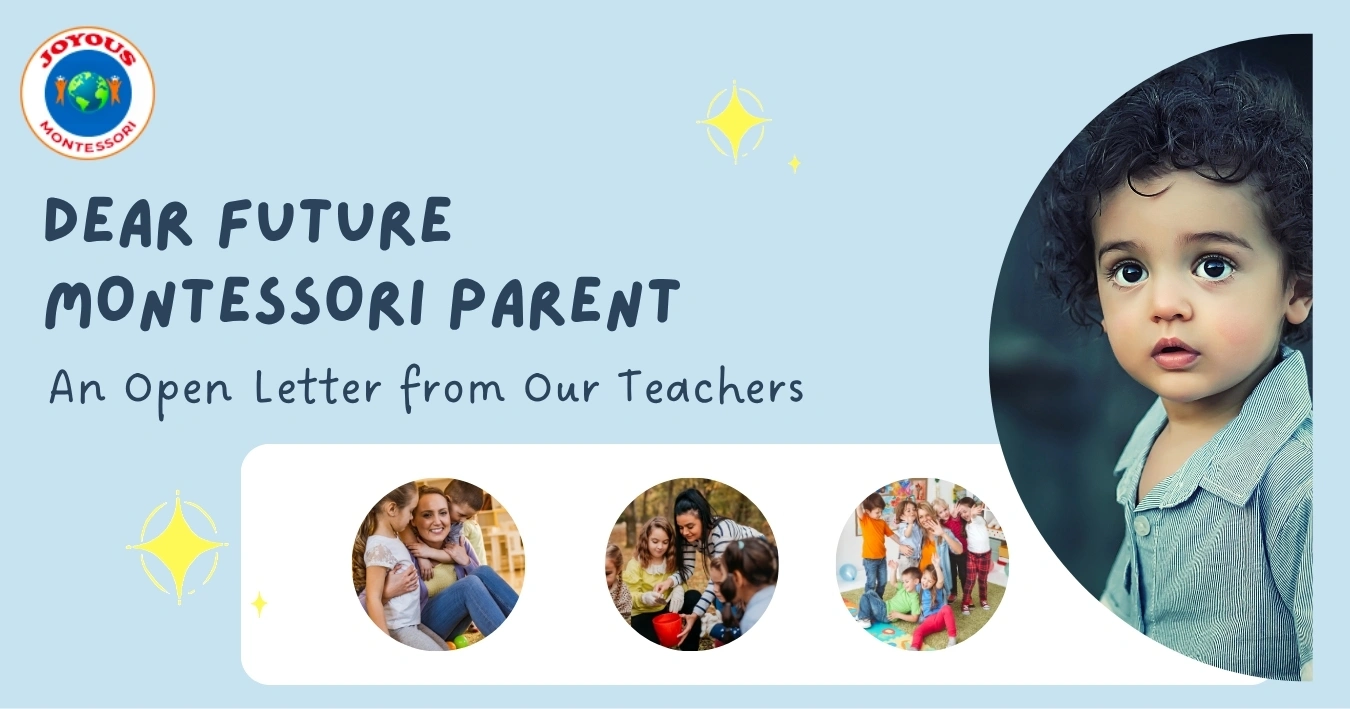
Future Montessori Parent Featured image
Future Montessori Parent Blog

Dear Future Montessori Parent,

First — welcome! You’ve already taken a courageous first step by exploring Montessori education for your child. That alone tells us so much about you: You value curiosity, kindness, creativity, and a joyful learning journey.

Here at Joyous Montessori, we often say that we don’t just teach children — we walk alongside them as they unfold into who they are meant to be.

This letter comes from our hearts to yours, because we know the choice you’re making is about much more than academics. You’re choosing the environment in which your child will discover themselves, the guides who will support them through wonder and challenge, and the community that will cheer them on every step of the way.

Montessori is a Different Kind of Magic

We know — “Montessori” can feel like just another buzzword at first. You’ll hear about hands-on learning, the mixed-age classrooms, the freedom within limits, the focus on independence.

But what we want you to know is this: Montessori is not just a method. It’s a mindset. A way of seeing each child — your child — as a unique, capable, brilliant human being.

Montessori Is a Different Kind of Magic

When your child steps into our classroom, they won’t be asked to conform to someone else’s expectations. Instead, they’ll be encouraged to follow their natural curiosity. To explore. To choose. To wonder. To make mistakes and try again.

The shelves are lined with carefully designed materials — not just for “fun” but to awaken a sense of mastery. The lessons unfold gently, according to each child’s readiness. The classroom hums with joyful focus because the children feel ownership over their learning.

In this space, your child will grow not just in reading, math, and science — but in confidence, grace, empathy, and resilience.

A Partnership with You

Here’s something we want you to hear clearly: You are not handing your child off to us. We are becoming partners in your child’s journey.

We welcome your insights. We celebrate your child’s milestones together. We hold space for the big emotions — theirs and yours — as your family transitions into this next chapter.

You’ll receive regular communication about what your child is working on. You’ll be invited into the classroom for special events and observations. You’ll meet a community of like-minded parents who also believe in raising kind, curious citizens of the world.

We often say that Montessori education flows naturally between school and home. Many parents find themselves inspired to create similar spaces at home — quieter, more intentional, more empowering for their children.

A Partnership with You

Preparing for More Than Kindergarten

As you consider enrolling for the 2025–26 school year, you’re probably thinking about your child’s readiness for Kindergarten and beyond.
Know this: a Montessori foundation equips your child with exactly the tools they’ll need not only for Kindergarten, but for life.
Preparing for More Than Kindergarten

Independence: They will learn how to initiate, persist, and complete tasks with confidence.
Focus: Through self-directed learning, they’ll build remarkable concentration skills.
Emotional Intelligence: Collaborative mixed-age classrooms foster empathy and leadership.
Love of Learning: Perhaps most importantly, they will associate learning with joy, not pressure.

Montessori kids often transition beautifully into diverse educational settings — because they have learned how to adapt, advocate for themselves, and remain curious.

Why Now is the Time

We want to be transparent: our enrollment for 2025–26 is already filling quickly. The families who know us well often re-enroll year after year, and we limit class sizes to preserve the integrity of the Montessori experience.

If you are even considering joining our Joyous Montessori family, we encourage you to schedule a personal tour.

When you visit, you’ll see for yourself the sparkle in our students’ eyes. You’ll notice the respectful way teachers interact with children. You’ll witness the magic of children taking ownership of their learning.

A Final Word from Our Hearts

Dear future Montessori parent, we see the love you hold for your child. We know how carefully you are choosing their path.

If you choose us, please know this:

With warmth and gratitude,
The Teachers of Joyous Montessori

Ready to Begin?

Enrollment for 2025–26 is now open — and we’re offering 20% OFF your first month’s tuition for new families!

👉 Schedule your personal tour today: joyousmontessori.com/enroll
👉 Call us: (817) 431-6661

We can’t wait to meet you and your child. 🌟

Kindergarten Blog Featured
Kindergarten Banner image
As a parent, you want your child to enter kindergarten feeling confident, curious, and ready to thrive. But how can you ensure they have the right foundation for success? At Joyous Montessori, we believe that education should be more than memorizing letters and numbers—it should nurture independence, creativity, and problem-solving skills. Our Montessori approach helps children build a strong academic and social foundation, making their transition into kindergarten smooth and setting them up for lifelong success. In this blog, we’ll explore how Montessori education equips children with essential skills, ensuring they flourish in kindergarten and beyond.

1. Montessori Fosters a Genuine Love for Learning

Many children enter traditional kindergarten classrooms accustomed to structured, teacher-led learning. While structure is important, Montessori education takes a different approach—one that nurtures natural curiosity and a love for learning.

Montessori Fosters a Genuine Love for Learning

At Joyous Montessori, we create an environment where children are excited to explore new concepts. Our curriculum encourages:
Hands-on learning with real-life experiences
Self-directed activities based on a child’s interests
Engaging, multi-sensory materials that make learning fun

This approach ensures that children enjoy learning rather than feeling pressured. When a child loves to learn, they carry that enthusiasm into kindergarten, elementary school, and beyond.

2. Strong Academic Foundations for Kindergarten Readiness

A strong academic foundation helps children feel confident and prepared when they enter kindergarten. At Joyous Montessori, we introduce fundamental concepts in a way that is both engaging and developmentally appropriate.

Language & Literacy:

  • Phonics-based reading instruction
  • Storytelling and vocabulary building

Mathematics & Problem-Solving:

  • Hands-on learning with number rods and counting beads
  • Introduction to addition, subtraction, and number patterns

STEM & Science Exploration:

  • Simple science experiments that encourage curiosity
  • Nature studies and hands-on discovery

By the time children transition to kindergarten, they have confidence in their abilities and a solid academic foundation to build upon.

Strong Academic Foundations for Kindergarten Readiness

3. Encouraging Independence & Self-Discipline

One of the biggest benefits of a Montessori education is how it encourages independence from an early age.

Encouraging Independence & Self-Discipline

In our classrooms at Joyous Montessori, children learn to:
✅ Make their own choices within structured boundaries
✅ Complete tasks independently, such as pouring, tying shoes, and organizing materials
✅ Take responsibility for their learning and daily routines

This sense of self-sufficiency helps children transition smoothly into kindergarten, where they will need to follow instructions, manage their time, and complete tasks on their own.

4. Social & Emotional Development

A child’s ability to express emotions and communicate effectively is just as important as their academic skills. Montessori education nurtures emotional intelligence in several key ways:

Teamwork & Collaboration: Children work together on group activities, learning the importance of cooperation and empathy.

Communication Skills: Through storytelling, conversations, and group discussions, Montessori students develop strong verbal and social skills.

Conflict Resolution: Instead of punishment, Montessori classrooms emphasize problem-solving and understanding emotions, helping children manage their feelings and relationships.

These skills allow children to enter kindergarten with confidence and emotional maturity, making it easier for them to engage positively in a group setting.

Social & Emotional Development

5. Developing Critical Thinking & Problem-Solving Skills

Success in school—and life—requires the ability to think critically, analyze situations, and find creative solutions.

Developing Critical Thinking & Problem-Solving Skills

At Joyous Montessori, we encourage:
Open-ended questioning that stimulates curiosity
Hands-on problem-solving activities that challenge children to think creatively
Experiential learning, where children explore different ways to tackle problems

Rather than simply memorizing facts, Montessori students develop the ability to think independently, adapt to new challenges, and find solutions—skills that will benefit them not just in kindergarten but throughout their entire academic journey.

6. A Smooth & Confident Transition to Kindergarten

Parents often wonder how their child will adjust when moving from Montessori to a traditional kindergarten classroom. The good news? Montessori students transition seamlessly because they already have the essential skills needed to succeed.

They are independent learners who can manage tasks and follow instructions.
They are socially prepared, having practiced communication, cooperation, and emotional intelligence.
They have a strong academic foundation, making them confident in reading, math, and problem-solving.
They adapt well to structure, as Montessori classrooms balance freedom with responsibility.

At Joyous Montessori, our goal is to make sure children enter kindergarten feeling confident, capable, and excited to learn.

A Smooth & Confident Transition to Kindergarten

Why Parents Choose Joyous Montessori

At Joyous Montessori, we are dedicated to giving children a strong start in life through engaging, hands-on learning in a nurturing environment.

Certified Montessori educators with years of experience
A safe, supportive, and structured learning environment
A curriculum tailored to each child’s unique needs and learning pace
An emphasis on practical life skills, emotional growth, and academic excellence

We understand that early education is the foundation for future success, and we are committed to preparing children for a smooth and confident transition into kindergarten and beyond.

Give Your Child the Best Start at Joyous Montessori!

If you’re looking for a Montessori school that truly prepares your child for success, Joyous Montessori is the perfect place to begin their learning journey.

Call us today at (817) 431-6661 to schedule a tour!
Visit our website: joyousmontessori.com

Invest in your child’s future success and happiness with Montessori education at Joyous Montessori—where learning is joyful, meaningful, and lifelong!

Joyous Tuition Blog Featured
montessori tuition blog banner

Montessori education is renowned for its unique approach to nurturing creativity, independence, and lifelong learning. As parents, providing this high-quality education to your child can feel like a priceless investment. However, the tuition fees associated with Montessori preschools often become a major family consideration. If you’re looking for practical ways to afford Montessori education, this guide offers tips and insights to make it more accessible without compromising quality.

1. Understand the Value of Montessori Education

Before diving into ways to afford tuition, it’s essential to understand what sets Montessori schools apart. Montessori preschools emphasize hands-on learning, self-directed activities, and individualized attention. They offer a nurturing environment that caters to each child’s learning style and pace. With these benefits, the tuition is often an investment in your child’s long-term development, making it worth prioritizing in your budget.
Understand the Value of Montessori Education
Explore Tuition Discounts and Offers

2. Explore Tuition Discounts and Offers

Many Montessori schools offer discounts, scholarships, or special promotions to help families manage the costs. For instance, Joyous Montessori Preschool in Keller, TX, provides 20% off the first month’s tuition and 50% off the second month’s tuition. Always inquire about such offers and stay updated on promotional deals to save on initial costs.

3. Look for Scholarships and Financial Aid

Scholarship programs are a valuable resource for families looking to afford a Montessori education. Some schools provide need-based scholarships or grants to eligible families. Additionally, local community organizations and educational nonprofits may offer financial aid specific to early childhood education. Don’t hesitate to ask the school administration for guidance on available options.
Look for Scholarships and Financial Aid
Set Up a Savings Plan

4. Set Up a Savings Plan

Planning can make Montessori tuition more manageable. Start by setting up a dedicated savings account for your child’s education. Contribute regularly to this fund—even small amounts add up over time. Automated savings plans can simplify the process and ensure consistent contributions.

5. Budget for Education

Careful budgeting can free up resources for your child’s education. Review your monthly expenses and identify areas where you can cut back. For example, consider reducing discretionary spending like dining out or entertainment. Redirecting these funds toward tuition ensures your child’s education remains a top priority.

Budget for Education
Consider Employer Benefits

6. Consider Employer Benefits

Some employers offer childcare or education benefits as part of their employee packages. Check with your HR department to see if your company provides tuition reimbursement, dependent care flexible spending accounts (FSAs), or other educational incentives. These benefits can significantly ease the financial burden of Montessori tuition.

7. Utilize Tax Credits and Deductions

Certain tax benefits may apply to preschool tuition or childcare expenses. The Child and Dependent Care Tax Credit, for example, allows parents to claim a portion of qualifying childcare costs, which may include Montessori preschool tuition. Consult a tax professional to understand which credits or deductions you’re eligible for.

Utilize Tax Credits and Deductions
Flexible Payment Plans

8. Flexible Payment Plans

Many Montessori schools offer flexible payment plans to accommodate families’ financial needs. Instead of paying the tuition in one lump sum, consider monthly or quarterly installments. This approach can make tuition more affordable and easier to incorporate into your budget.

9. Choose Half-Day or Part-Time Programs

If full-time tuition feels out of reach, consider enrolling your child in a half-day or part-time Montessori program. These options provide the same high-quality education while reducing costs. Part-time programs are a great way to balance affordability with access to Montessori learning.
Choose Half-Day or Part-Time Programs
Plan for Sibling Discounts

10. Plan for Sibling Discounts

If you have more than one child attending Montessori school, ask about sibling discounts. Many schools offer reduced tuition for additional children enrolled in their programs. This policy can make Montessori education more feasible for families with multiple children.

11. Prioritize Montessori Education in Financial Planning

Affording Montessori tuition requires aligning your financial goals with your educational priorities. Treat your child’s education as a key financial goal, alongside savings for retirement or a home. Regularly revisit your financial plan to ensure it aligns with your long-term objectives.
Prioritize Montessori Education in Financial Planning
Ask for Referrals

12. Ask for Referrals

Some Montessori schools provide referral discounts for families who bring in new enrollments. If you know other parents considering Montessori education, encourage them to visit the school and mention your name. Referral incentives can lower your tuition costs while helping other families discover Montessori education.

13. Seek Local Grants or Assistance Programs

Inquire about local or state-level grants that support early childhood education. Some regions provide subsidies for families enrolling in accredited preschools. Researching these options can uncover additional resources to help fund your child’s Montessori education.
Seek Local Grants or Assistance Programs
Invest in the Long-Term Benefits

14. Invest in the Long-Term Benefits

While Montessori tuition may seem like a significant expense, it’s crucial to consider the long-term benefits. Montessori education fosters independence, critical thinking, and a love for learning, giving your child a strong foundation for future academic and personal success. This investment pays dividends throughout their lifetime.

Final Thoughts

Montessori education is an incredible gift you can give your child, and with thoughtful planning, it’s possible to make it more affordable. By exploring discounts, budgeting wisely, and leveraging financial aid, you can provide your child with the unique opportunities Montessori education offers. At Joyous Montessori, we’re committed to supporting families in creating a nurturing and enriching educational experience for their children. Contact us today to learn more about our tuition options, promotions, and programs designed to help your child thrive.